Thursday, 19 March 2015

Missing my rusticity

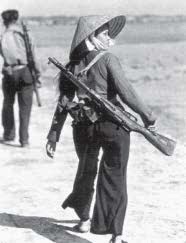
During the French revolution, the march to Versailles was an example of feminist militant activism despite being the passive citizens who had no political rights and trained to be good mothers and wives. Women matched men in clearing the jungles to make North America habitable. When the world wars consumed men, women became the breadwinners furthermore shouldering the obligations to uphold the society. In Vietnam war women contributed by helping in nursing the wounded, constructing the famous Ho Chin Minh trail and airstrips. They neutralized tens of thousands of bombs, transported tens of thousands of kilograms of cargo, weapons and food and shot down fifteen planes. After the war, they worked in agricultural cooperatives, factories and production units.


In all these instances, women confronted the cultural norms and years of subjugation. They nullified the prevalent perception of being tender and helpless; proved their ability to be strong and defiant human beings. They reinforced the true nature of a human spirit that aspires to freedom and equality. The spirit that inconsequential of being a man or woman cannot be dominated by practised societal norms. These troubled times must have imprecised the gender disparities. However as the hardships ended women were shoved into their domestic moulds testifying their tenderness inappropriate for the world’s hideousness.

I prefer the troubled times that give us an opportunity to be human not women and protest to fit the mould that prompts women to be preferably beautiful, presentable and a surprise bonanza if they are intelligent too. I am bored with seeing women who try hard to look gorgeous, starve themselves to fit into some modelled outfits and above all end up mutilating their identities that lie beyond the appearances. I am as human as a man, why can’t I stay natural even if it is perceived as unbeautiful? Why do I need to undergo the elaborate (sometimes painful) prettification procedures and prove that I too am very much a woman? It is fine for me to sit in the audience than to be a member of an organising committee for being pretty.

It might be a personal decision to choose the way I look but being a part of the social order looks have their own benefits. Lured by them I too end up riding the bandwagon with a wish to dissociate myself from this mania and enjoy my rusticity.

Wednesday, 18 March 2015

Statistics and development

Numbers are amazing beings! yes they have life because they rule us.

Humans devised numbers for their ease to estimate and analyze the proximate world. The comfort
facilitated by the numbers coerced humans to extend their applicability. Sooner the numbers enveloped the human imagination and became the currency of his ambitions, thus preying on his vulnerability to be on the top. Now these numbers govern the people, economy, nations and their development. There is a steeplechase of improving on the survey charts that epitomise the perfect and  conducive life. But are these numbers real paradigm of wellness or is it another marvel of a fabulous text called ‘statistics’?

Numbers known as GDP, inflation, per capita income, the Sensex and many more ascertains the health of a nation. To a commoner, the improvement in the figures of these entities provides a sigh of relief as it nurtures a hope of a better economy and easy life. But what startles me is an improving economy where the lack of accessibility of basic amenities remains same for a large fraction of the population. Inflation rate is lowered, but eatables continue to float at soaring rates. Here comes the role of delicate intricacies of statistics. 

Statistics is a science of the collection, analysis, interpretation, presentation, and organization of data. It is a brilliant technique that helps to enhance the presentability of data. So, the same set of information when applied to different analysis yield antithetical interpretations. This accounts for the incongruities between the facts and the projected data. The statistics contribute an average state to the involved population though the state of the populace is individualistic.

Hence, we must try to scrutinize the illusion sponsored by these numbers and look beneath them, the nonstatistical ground reality.

Friday, 13 March 2015

Satta annihilates rajneeti

One thing is assured; in Indian polity leaders enjoying the power are perceived as corrupt who jeopardize national interests for their own selfish motives. Whereas those in the opposition are committed nationalists, they don’t give way to the anti-proletarian opportunists. Interestingly this outlook overwhelms the confines of party politics. Sometimes I feel that the opinion on the issues is pre-conscripted for the government and opposition flanks. Thus, their views are not being guided by their own intrinsic judgment or party philosophies but by being in the government or opposition.

Recently the issues like women security, FDI, land acquisition bill, border disputes, and release of separatist leader have been dealt in the said manner. When in opposition the politicians observe these issues as atrocious, anti-nationalist that demean indigenous competence. However, being in the government same subjects are perceived as inevitable for nation’s growth and silence is favored over others. This indifference has crept among the masses, as they feel dejected when the people in government change but not the governance. It seems the government and opposition have liaised to stage the ideological friction only to fool the people and secure their vote bank. The explanations in support and opposition lack the precision and a benefitting to all approach.

Even after 67 years of independence our politicians have failed to extricate the rajneeti from satta. Where former objects at ‘the art or science of government or governing, especially the governing of a political entity, such as nation, and the administration and control of its internal and external affairs’ the later emphases on the ‘activities aimed at improving someone's status or increasing power within an organization.’ They are still mortgaging rajneeti for satta.

Wednesday, 11 March 2015

Vulnerability and Beauty

Nature is endowed with variance the mammoth, the miniscule, the vivacious, the lethargic, the bright, the dull and so on. Besides the diversity, it never failed to infuse a mechanism of self-preservation. Every tiny soul is armored to persist the adversities of survival along with the vulnerability to succumb to those challenges. Man is graced with a fragile body and a strong spirit that has helped him to maneuver its way through the evolution. A peculiarity of human evolution is the discrete and contentious role ascribed to men and women.

Male/female distinction occurs across the animal kingdom where they are innately channeled to assume their onus. Female subjugation seems to be non-existent contrariwise their manhandling is prevalent in humans and gorillas with exception. Amongst humans, men are emboldened with physical strength for their defense whereas women are gifted with beauty and fragility thus enticing men for their protection. Therefore, radically it is justified for men to rehearse their strength and women their beauty for their safeguard. In a civilized society, such perception is an abomination.

Man exercising his brute force is perceived as a strongman ‘bahubali’, this earns him a social status. If he channels it in non-social determinations, he is convicted yet continues to enjoy the societal privileges. Conversely, so does not happen with women; women employing their charismas to advance in life are contemplated as iniquitous, derogatory and they seize to be a part of the civilized world. Is this to shield the culture from immorality or to seal the chinks of vulnerability in male armor? Who laid the model conduct that prevents women from exercising their strength, furthermore takes pride in men flaunting their muscle power? Or is the society too nascent that can survive the demands of male autonomy but is naive to embrace women liberation?

Tuesday, 10 March 2015

If plants could talk?

Nature bestowed upon us the gift of speech; it blessed animals with the ability to produce sound but why at all it chose to neglect plants? As a child, I always wished if somehow they could express that I was taking good care of my little saplings. It never happened, and I could never unfold the nature’s prejudice. However, I concluded the reason to be, their being sedentary. Nature attributed vocals to the animals so that the others could be aware of their presence, help them to communicate and live in a society. Plants survive solitude yet never secede to deliver life.

Imagine if plants could speak? Man would have been its worst victim, and it would be difficult to promote vegetarianism. At least it would have reduced one parameter of differentiation, the cult Indian classification of vegetarian and non-vegetarian. The demarcation would have blurred because plants if not resisted, would have squealed being plucked for fruits, flowers, or leaves. The logic of preferring vegetables to flesh in the name of evading brutality against animals is elusive as both have life and constitute an eternal part of the food chain. People who rip the plants off the flowers during  the morning walk would be caught for the slaughter done in the name of worship. The deforestation caused to provide access for the development projects would be a shrieking hell and the plants would require anaesthetization prior plucking. Then there would be a PETP (People for Ethical Treatment of Plants) and several other similar outfits.

It would have been a chaotic world to visualise. Nature chose the plants to be speechless thus impregnating them with the obligation to nourish life without articulating their aggravations. So, it does to the human. People who have the ability to render themselves for the world’s furtherance never protest. Therefore, being silent should not be interpreted as a signature of docility but of the magnanimity and endurance of letting others prosper.

Friday, 6 March 2015

Check your sensitivity!

Just finished watching the BBC documentary ‘India’s daughter’. Accolades to the Director, for sensible portrayal of the nuances of the unfortunate incident. It is not a clichéd cheap dramatic representation as depicted in our Primetime crime shows. However, pertaining to its ‘sensitive’ content the government is determined to bar it from public view, but one needs to be sensitive about it. Tihar Jail DG served a notice to the BBC for taking commercial advantage of it. Instead of appreciating the effort for unraveling the grievances of the victim’s associates and the individual opinions of the people involved; the DG is worried about the commercial aspect. How to counter this skewed parochial vision?

The pertinent question is how to stop the perpetration of such heinous crimes? Can educating people help? I don’t think so because court’s record rooms are brimming with the high-profile cases where the educated, sophisticated and privileged are the culprits. If education means good schooling then I should admit that being educated in a school that holds the Guinness world record for enrolling maximum number of students in a city, I studied moral science as a subject up till class VI. For class VII and VIII moral science examination, I wrote the philosophy of our school and its motto. Beyond class VIII the school did not felt the need of moral education. So, is the case in other schools.

The convicts were unrepentant because atrocities against women are a part of their upbringing and their indifference to it is practical. Secondly, if their crime is punishable then the cases of the influential people, the MPs, MLAs inflicted with such allegations should also be put on fast-track trial. Thirdly, why is their case treated differently when we have scores of assault cases complimented by inhuman acts? Here, we need to understand that corporal punishment is not a treatment for the perception-based ailments. Ideological disorientation can only be cured by ideological refinement.


As a society, we are adapting to globalization, where traditions, values, and beliefs are reshuffling and in this contagious stage we need to redefine the social infrastructure and responsibilities. We want educated, self-reliant women ingrained with traditional values who  can shoulder all the domestic responsibilities.  The pace of adaptation is not same across all the stratus; therefore, men will have to invent a conducive atmosphere to achieve this. As it was Rajaram Mohan Roy, who challenged men’s intolerance for women emancipation. The reason that can be deduced for such crimes is the loss of sensitivity. We have become insensitive as a society. We need to inculcate this basic human emotion, which is a cohesive force and must have been the seed around which humans crystallized to form a society.